

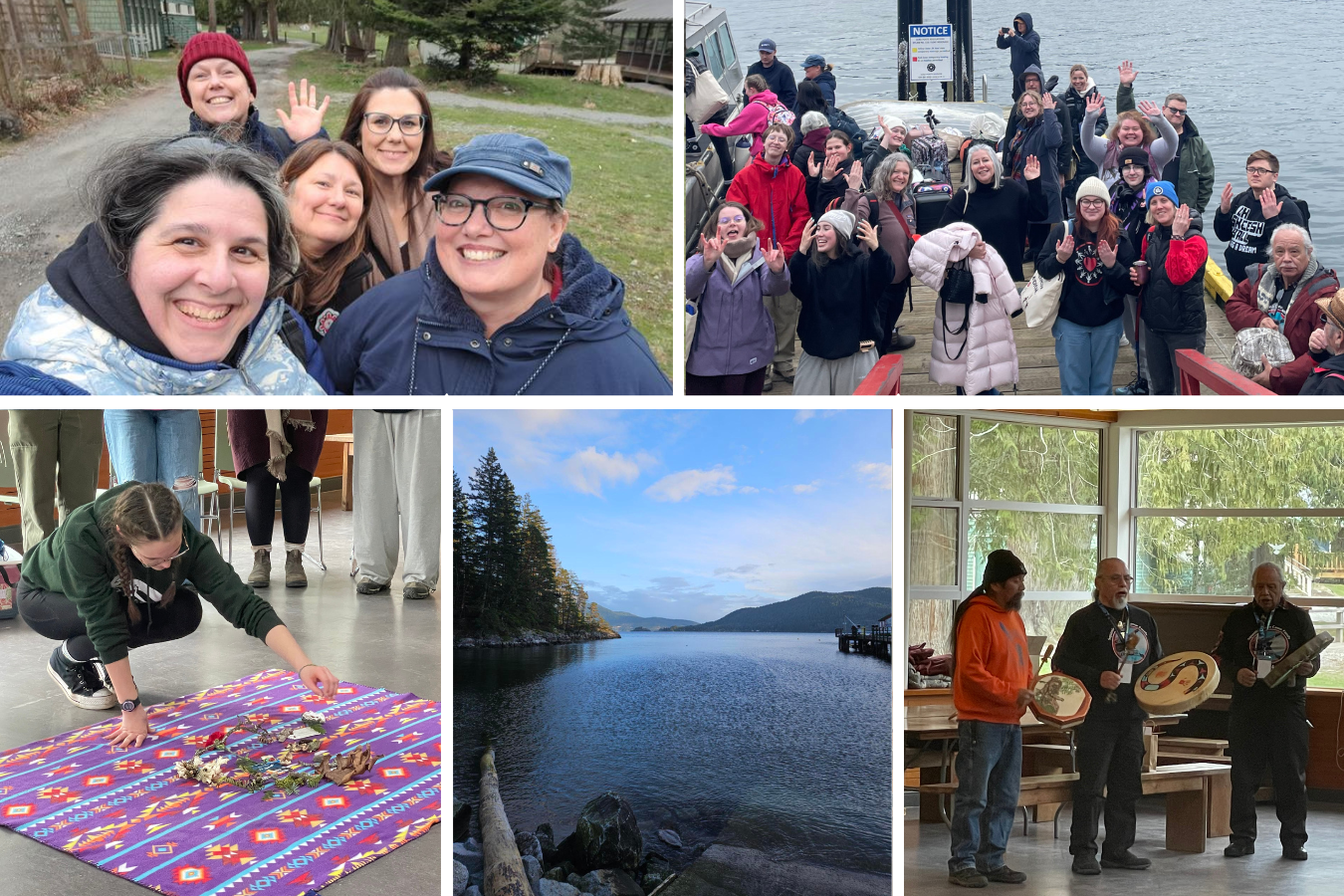
I’m just back from a beautiful and grounding LeaderShift event, the Decolonization is a Community Act retreat. Hosted by Camp Fircom on Chá7elkwnech (Gambier Island), ministry personnel and lay leaders, including young adults and older youth, were led by elders, storytellers and knowledge-keepers of the Sḵwx̱wú7mesh Úxwumixw (Squamish Nation).
We were blanketed, gifted with story, song, teachings – all medicine for the heart, mind, body and spirit. We were reminded how important language, culture and traditions are to a people – expressing, embodying and holding truths about relationship with the land, the Creator, and one another.
It made me wonder about the ways we intentionally immerse ourselves in the culture of the gospel, the ways of the kin-dom of God that Jesus proclaimed and embodied.
Sometimes we are tempted to abandon traditional Christian language and liturgy, and often for very good reasons, when it is harmful, abusive or contrary to our understanding of who God is and what it means to follow Jesus. We try to avoid behaviour, language or practices that make us look different to the rest of the world. As if we want to communicate, “Don’t be threatened by us! We might go to church on Sunday, but we’re really just normal nice people.”
Yet spending the week with Squamish nation elders, storytellers and knowledge-keepers, I was so grateful for all the ways they have stubbornly refused to give up their language and culture, their ways of forming their young people, and of being in relationship with the Creator, the land and each other. The teachings I received last week are beyond measure, and are still working away in me (after a week of holding up my hands, palms toward me, over and over again to express “thank you” in the Squamish way, I found myself doing it in a meeting today – it had become part of me).
In his recent book, Weird in the World: Living Toward the World God Wants, my friend and colleague, Rev. Aaron Miller says, “Christians are meant to be weird enough in the world that when God gets the world God wants, we fit right in.”
If this is true, and I think it is, then there are language and practices that I would hate to see us lose.
The Circle of the Christian Year is one way we immerse ourselves in the language and culture, vision and values, of the gospel. Often counter to the movement and energy of the secular world and the earth (at least in the northern hemisphere), we followers of Jesus find ourselves being weird.
Embracing the season of Advent as a time of intentional preparing for the mystery of the incarnation (rather than a month-long marathon of parties, shopping and eating). Paying attention to the ways God is giving hope, peace, joy and love. Remembering the ways love and life grow hidden often, in the darkness, while we wait.
Or practicing the season of Lent as a time to prepare for the mystery of the resurrection, to take seriously the trouble the world is in, and the ways we are complicit in and wounded by it. A time for telling the truth about our lives and our world, and how hard it can be to follow Jesus to the cross. A time to practice trust that the journey down and deep, into costly love, self-giving and losing our life for the sake of the gospel, is also paradoxically, the way we find true freedom and life, and that there’s no way to bypass the journey. You can’t go around it… you have to go through it.
And practicing the season of Easter, the whole 50 days until Pentecost, because the glory and mystery and paradox of the rising, can’t possibly be celebrated and explored in just one day of chocolate and bunnies (as much as I love chocolate). Joyfully expecting to be surprised by recognizing the Risen One, where and how and in whom we least expect it. Finding others on the journey of discipleship, embodying together what it means to be church, learning over and over again how to speak and live and share the gospel.
Yup, it all sounds pretty, pretty, pretty weird. Thank God we have companions who are just as weird as we are, and a God whose mystery and weirdness outmatches our own.
Keeping it weird, this Lent and beyond,
Michelle